
 Login
Login
Lock Mechanisms
There are four types of locking mechanisms, each wit their own unique features. It’s important to select the best mechanism for your project before you start picking out hardware.
IMPORTANT: Hardware must always be selected and ordered AT THE SAME TIME AS THE DOOR to avoid delays and complications. Glenview Doors are 2-3/4″ thick, so we have to special-order any hardware to make sure it will fit properly. If you source your own hardware, you are responsible for the fit and compatibility.
Lock Preparation: This is the carving, routing, and drilling we need to prepare the door slab for your hardware. Each type of locking mechanism requires a different preparation with a different price. The price of the lockset hardware does not included lock preparation. We’ve included information about the lock prep required for each mechanism.
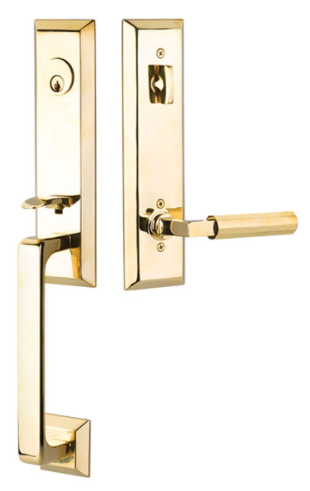
Tubular Lock
This is the most common type of locking mechanism. It has a standard deadbolt and a latch. The deadbolt needs to be locked manually, either with a key from the exterior side, or the thumb turn on the interior side. Since this is the most popular mechanism, it has the most style options and it is the most affordable.
We offer two types of lock preps for tubular locks:
Partial Prep – Our team will drill two face bores, but we don’t do the edge prep, strike plate, or hardware installation. Ideally, the edge prep and strike plate should be done on-site after the door is installed to ensure perfect alignment. This is the ideal preparation for most projects and the most affordable option.
Full Lock Prep – Our team does everything required, including installing the hardware. This is ideal for builders who aren’t comfortable doing the edge prep or hardware installation on-site. However, if the door isn’t installed perfectly level and square, the alignment will need to be adjusted. Glenview Doors Inc. is not responsible for the final alignment if you choose this option for your project.
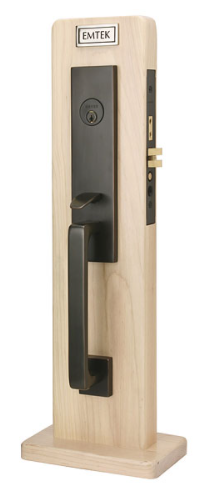
Mortise
This mechanism comes with an Auto-Locking function, thicker deadbolt, and easy egress system, which makes it more secure than a tubular locking mechanism. Most people can identify this mechanism because it has a button on the edge of the door to turn off the auto-lock function. The auto-locking function does increase your chances of someone getting locked out. It’s important to have a secondary keyless ingress, particularly if your in a region with dangerous weather.
Mortise Lock Preps are more complicated than tubular and require more labor. We have two options to choose from
Partial Lock Prep – Our team carves out the pocket in the edge of the door to house the mortise mechanism. They do not cut for the face bores or strike plate, and they do not install the hardware.
Full Lock Prep – The Glenview Doors team does everything from carving out the mortise pocket to installing the hardware. As with a full tubular lock prep, the alignment might need to be adjusted after installation.
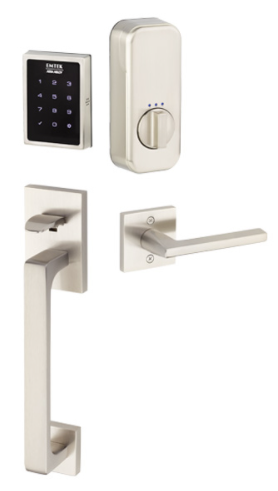
Smart Lock
Smart locks allow for key-less entry options. This could be opened with a keypad or from your phone. The actual mechanism is a tubular lock, it’s only the operation that’s different. This is preferred by people who have young kids who aren’t yet responsible enough for keys, or frequent guests where keys would be inconvenient. The only smart hardware currently approved for Glenview Doors is the EMTEK Empowered system. It works with the Yale App which allows you to change the password remotely.
IMPORTANT
- Smart locks are not available on pivot doors or aluminum clad doors because they are thicker than the standard 2-3/4″.
- Smart locks can’t be paired with pull bars or our multipoint locking mechanisms because they aren’t powerful enough to open and close the latches.
- You can select smart lock models other than the EMTEK EMPowered, but Glenview Doors Inc is not responsible for any fit, function, or compatibility issues. We will not source, install, or prep for hardware that isn’t sourced by Glenview Doors. The EMTEK EMPowered line is the only one that has passed our user reviews and can be reliably modified to work with our door thickness.
Lock Prep – Smart locks require a standard tubular prep, but we need to do an additional modification due to the door thickness. This makes this preparation more labor intensive, and this modification can’t be done by anyone outside of Glenview Doors Inc. If someone purchases a smart lock device, we have to do the full installation to avoid issues in the field. Partial preparations are not available for smart locks.
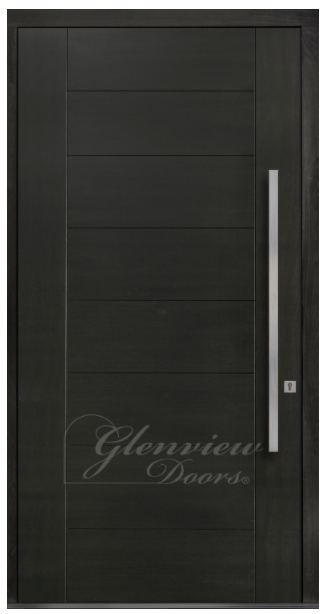
Multipoint Lock
This mechanism is designed to prevent warping. It also makes a door much more secure because it has three latches that connect the slab to the frame. Many manufacturers require multipoint systems on doors over 80″ tall, but our Euro Tech makes Glenview Doors so stable, that they aren’t required unless the door is over 96″ tall. Pivot doors, and aluminum clad doors come with multipoint locking mechanisms automatically. Multipoint systems can come with modern pull bars or lever-by-lever systems.
- IMPORTANT (PULL BARS): A pull bar on the exterior side of the door means that there is no lever to unlatch the door if you close it behind you, so you will need a key to open the door even if it isn’t locked. This makes it is easy to get locked out. There is a “Day Function”, which prevents the door from latching and avoids this problem, but if the door isn’t latched, it’s also not closed and could be pushed open. The Day Function is intended for special occasions, when you have parties or you’re moving and don’t want to be worried about constantly unlocking the door, it’s not meant for daily use. The easiest way to avoid the lock-out issue is to get a multipoint mechanism with a lever-by-lever system instead of a pull bar, but the pull bar is typically what attract customers to this system in the first place.
- IMPORTANT (SMART LOCK): Multipoint mechanisms can’t be paired with smart locks. There aren’t any smart locks that are strong enough to operate a multipoint mechanism for residential applications.
- IMPORTANT (STILE AND RAIL): In typical stile and rail doors, the stiles aren’t wide enough to accommodate a pull bar and the cylinder plate. We would need to build them a custom door with larger stiles. They can avoid this issue by going with a lever-by-lever option.
- IMPORTANT (LEVER-BY-LEVER): There are not many design options for multipoint lever-by-lever hardware. The options we do have can be found through EMTEK or Linea Cali. The levers sit 41″ from the ground, which is higher than the standard 36″. This means that if they’re on a stile and rail door, they won’t line up with a typical lock rail and it could look weird. They also can’t be paired with raised moulding because there isn’t enough room and someone could scrape their knuckles.
Lock Prep – This is a complicated preparation, partial preparations are not available. Our team has to carve a long channel with three pockets to house the mechanism, apply a strike plate for each latch, and install the hardware.