
 Login
Login
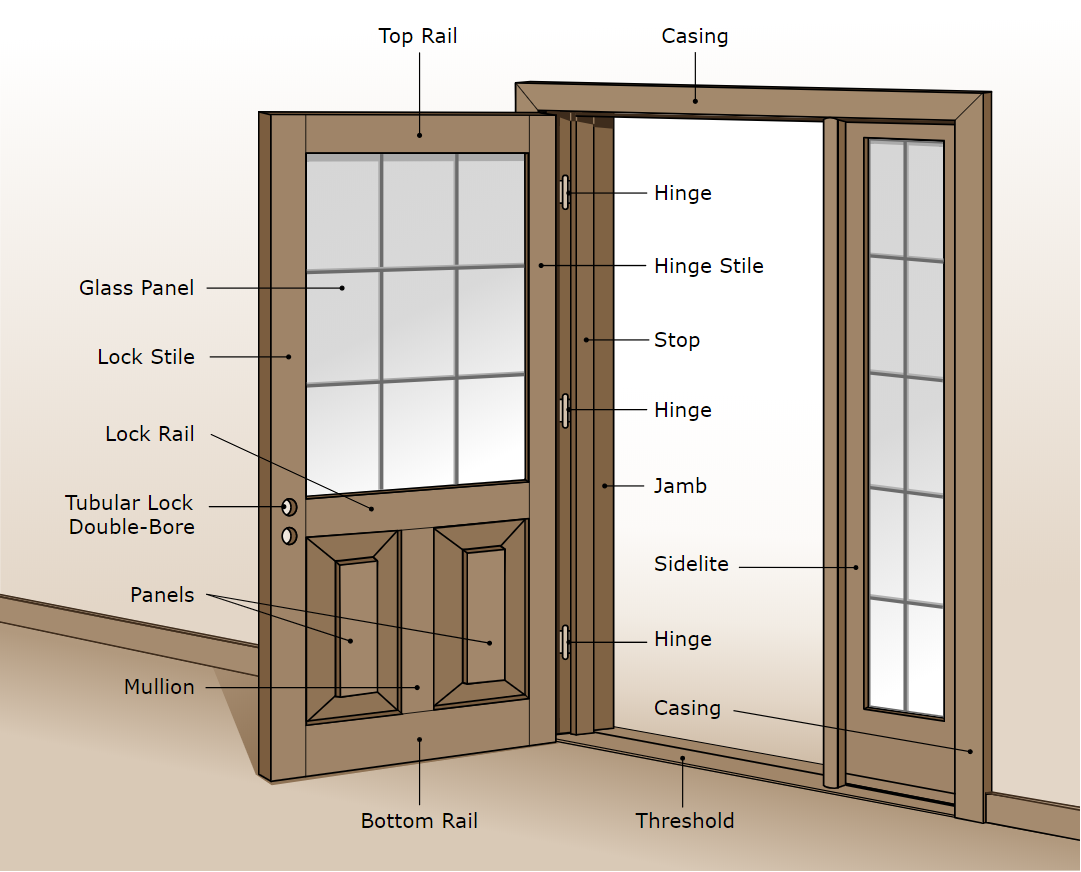
Door Terminology (A-H)
Active Door/Primary Door: This is the main door in a set of double doors. With our products, both doors in a set of double doors are able to open, but the primary door always has to open first. The Secondary Door is held in place with Flush Bolts.
ADA Threshold/Flat Threshold: This is a threshold that complies with the American’s with Disabilities Act. It is flat so a wheelchair has an easier time rolling over it. All doors for commercial projects are required to come with an ADA threshold. They are also required on pivot doors and outswing doors. If someone needs an ADA threshold, it is automatically a custom order.
Adjustable Threshold: This is the standard threshold which comes with all of our doors. It has a strip that can be adjusted up or down with several screws in order to customize the seal for different types of weather or humidity. This typically has to be adjusted seasonally.
Aluminum Cladding: A thick metal panel with a powder coating finish applied to the exterior side of a door to protect it from sunlight, impact damage, and extreme weather conditions. This makes a door virtually maintenance free and gives it a vault-like feel. A door with aluminum cladding must be equipped with concealed hinges and a multipoint locking mechanism to support the additional weight of the metal. Aluminum cladding is especially beneficial in hot, sunny climates.
Astragal: This is a component that covers the gap between a pair of double doors. On our doors, there is one part on the exterior side which is attached to the primary door, and one part on the interior side of the secondary door. They overlap and have weather stripping to prevent wind and water from coming in.
Backset: This is usually in reference to hardware. This is the distance from the center of the lock bore to the lock edge of the door. Standard backset for tubular locks is 2-3/8″, standard for mortise lock is 2-1/2″.
Beveled Glass: This is a decorative feature added to some glass. Each pane of beveled glass is triple glazed and individually sealed, which means beveled glass is always True Divided. Only clear or Satinato (frosted) glass can be beveled. True Divided Glass requires thicker mullions (2-3/8″) to protect the seal.
Bore: A hole cut into a door that allows for the installation of a lock. There are several types of locks which all require different bores and lock preparations, tubular, mortise, smart lock, and multipoint.
Brick Opening/Masonry Opening: This is a doorway built from any type of stone. Sometimes we need the dimensions of the brick opening when selecting the proper unit size for a project. It is the same size as the door unit WITH the brickmould because this always need to fit within the dimensions of masonry opening. A brick opening is not a suitable substitute for a unit size.
Brickmould: This is decorative trim which is applied to the exterior side of the door to cover the gap between the building and the frame. The door unit should always be slightly smaller than the rough opening, and this gap is typically messy with insulation and shims after installation. The brickmould covers this up and it’s stained the same color as the door for a neat finish. Brickmould has nothing to do with brick, any building material will probably require brickmould unless the builder has another plan design feature in mind to cover this gap. The interior side of the door will need casing to cover this gap, we don’t provide casing.
Caming/Leading: A metal strip used to hold pieces of smaller decorative glass in place to create a pattern. It’s also called leading in reference to stained glass.
Casing: Decorative trim attached to the interior edge of a window or door frame. It covers the gap where the door frame meets the wall. We don’t typically provide casing, the one exception is our modern interior doors which come with matching casing.
Concealed/Hidden/Invisible Hinge: A hinge that is not visible when the door is closed. It is mortised into the door slab and frame and is stronger than a typical hinge. It creates a cleaner look and is very popular on modern doors. Our in-stock doors can’t come with concealed hinges, they are only available on custom doors.
Deadbolt: The locking portion of exterior hardware. This is usually a large piece of metal that extends into the jamb of the door and keeps it shut even when the latch is retracted. The bolt can be retracted from the exterior side with a key or smart locking device. Mortise lockset hardware locks from both the deadbolt and the latch, but other locking mechanisms have latches that don’t lock.
Design Drawing: An architectural line image of a custom door that allows the customer to see what they are getting before they place their order. It is created by an in-house designer and is much less detailed than our Factory Drawings. Design Drawings are intended to finalize the visual aspects of an order, and might look slightly different from the final factory drawing.
Direct-Set: Used to describe a Sidelight or Transom which don’t have stile and rail construction, the glass is only held in place by the frame. It creates a cleaner, sleeker, more modern look and is often paired with flush, aluminum clad, and pivot doors.
Double Door: A single unit with two doors. With our double doors, both doors are always functional. The primary door must be opened first and the secondary door is held in place with flush bolts. Our double doors come with astragals to cover the gap between the doors and prevent wind and water from coming in. When both doors are open, there is no bar in the middle.
Double Rabbet Frame: A rabbet is a step carved into a material. A double rabbeted frame has two rabbets which creates a better seal for weatherproofing. Our pivot doors are all double rabbeted.
Double-Acting Door: Door which can swing both inward and outward. They are common on commercial kitchens. We don’t sell any double-acting doors.
Dutch Door: A single door that allows the top panel and bottom panel to open independently. The leaves are held together with a bolt.
Estimate: An approximate range of the price and lead time required for an order. We submit preliminary estimates through email, which are broad ranges provided before we have all the details to help the customer determine if our products will work for their budget and schedule. Official estimates are created in QuickBooks once all of the cost-related details have been determined. Estimates are subject to change until the order becomes a Sales Order.
Face Bore: A hole that is drilled into the front of the door as part of the lock preparation.
Factory Drawing: An architectural line drawing created before a door goes into production. This is rendered by the manufacturer and has all the true dimensions and technical specifications. A customer must review and sign this drawing before their order can go into production. the lead time doesn’t start until this document has been signed.
Floor Clearance: A measure of the space between the floor and the bottom of the door. This is typically only specified on interior doors. Sometimes customers need to adjust the clearance to allow for high-pile rugs or provide ventilation.
Flush Bolt: A bolt installed in double doors to hold the secondary door in place.
Flush Construction: A smooth door with no visible stiles or rails. This is common for projects which are aiming for a sleek, modern look. Flush doors are typically more prone to warping because of their construction, but our Euro Technology provides stability which avoids these concerns.
Frame: The structure that the door attaches to which creates the doorway. The frame is always designed to be perfectly compatible with the slab. The frame of one manufacturer won’t fit the door from another. If you measure a “standard” size door, you’ll find it’s never exactly 36″ x 80″. that’s because the manufacturer modified it to create a better seal with their frame.
French Door: This is not an official term, but it is generally used to describe a set of full-glass, double doors.
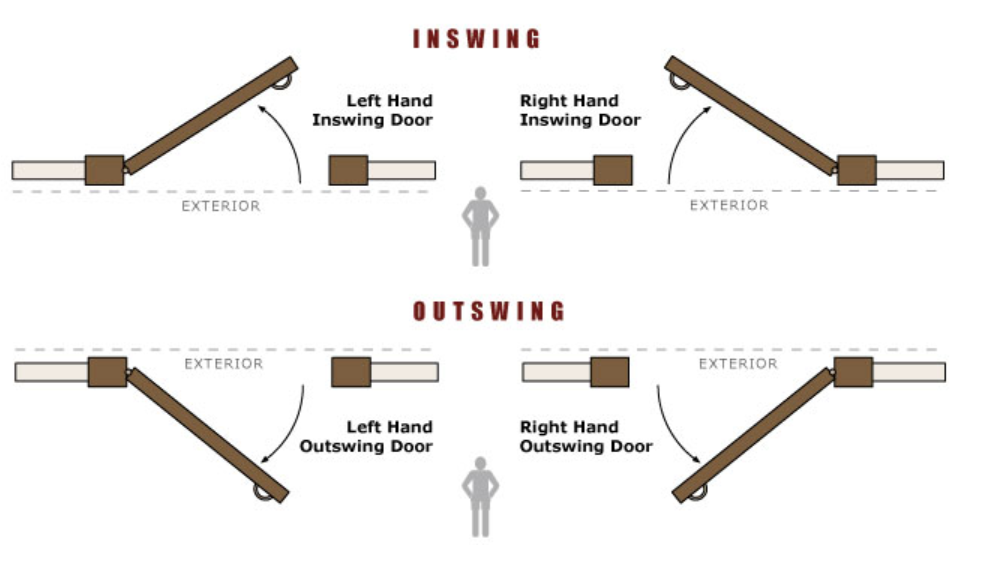
Handing/Swing: Describes the direction the door opens and the placement of the handle. The best way to determine this is to look at a door from the EXTERIOR side and see which side the HINGES are on. The door will naturally swing towards the hinges. If the hinges are on the LEFT, it’s a LEFT HAND door, if they are on the RIGHT, it’s a RIGHT HAND door. If the door swings INTO the structure, it’s an INSWING door, if it swings OUT, it’s an OUTSWING door. Commercial buildings are almost always OUTSWING and residential buildings are almost always INSWING. Outswing doors are always custom and must come with an ADA threshold. Pivot and concealed hinge doors are not available in outswing.
Hinges: The plates and pins used to attach the door panel to the frame allowing the door to swing open.
Door Terminology (I-P)
In-Stock: Doors which are already available in our inventory. They require a much shorter lead time and they have a lower price than our custom doors. However, they can’t be modified, they arrive exactly as described. We have many styles and common sizes to choose from.
Insulated Glass: A glass panel which is designed to keep indoor temps comfortable regardless of exterior temps. All of our glass panels are insulated to improve the U-Value of our overall product. Insulated glass is constructed from two layers of 1/4″ glass with a 1/2″ gap that is filled with Argon gas. Argon is inert, which means it doesn’t get hot when heated or cold when cooled.
Jamb: The vertical component of a door frame. Different types include the hinge jamb, upon which the hinges are attached, the strike jamb, upon which the strike is installed, and a blank jamb, which is not prepared for either a hinge or a strike plate.
Jamb Depth: A measure of the depth or width of the jamb, perpendicular to the door panel when closed
Knocked Down: Indicates that the product has been pre-assembled at factory, then subsequently unassembled and must be assembled on site.
Laminated Glass: There are two types of safety glass, Laminated and Tempered. Laminated glass is designed to break into a single sheet, so if the glass is ever hit with enough force to break it, it doesn’t shatter into tiny shards which can cause injury. Many windshields are made with laminated glass. All of our doors come with Safety Glass, but not all safety glass is laminated. The specific safety construction depends on the size, application, and texture of the glass.
Latch: The part of the lockset hardware which holds the door shut. Some latches can lock, like in the case of mortise locks, but usually they don’t. the deadbolt is the locking part of a typical lockset.
Lead time: The amount of time it takes to prepare an order. There are many variables which impact the lead time, like the type of product, if we have to order hardware or materials from a 3rd party, any custom pieces, or how busy our schedule is.
Leading/Caming: A metal strip used to hold pieces of smaller decorative glass in place to create a pattern. It’s also called leading in reference to stained glass.
Leaf/Panel: The flat portion of a stile and rail door. Panels can be made of glass or be solid. Traditional wood doors have floating panels which give the panel room to expand and contract without damaging the stiles and rails of the door. This leaves a small gap around the panels which can let in water and wind, particularly during colder months when everything contracts. Doors with Euro technology are so stable that they don’t need room to move, the panels are attached to the stile and rail which means there is no gap or weather penetration.
Lock Preparation: Every door must be modified to accept the lockset hardware that allows the door to close, lock, and operate properly. There are four types of lock preparations we offer, they are all for different types of lockset hardware; Tubular, Mortise, Multipoint, and Smart Lock. We offer full lock preparation which includes the hardware installation, and we offer partial lock preparations which is only the most complex parts of the process that are inconvenient to do on site.
Lock Rail/Middle Rail: Horizontal member of a door panel that is typically located where the locking mechanism would be installed, but could be lower or higher.
Low-e Glass: “Low Emissivity glass” has a thin coating which reflects infrared and ultraviolet rays to protect your home from sun damage and unwanted heat, while allowing plenty of sunlight in. All of our glass panels come with Low-e glass.
LVL Construction: Stands for Laminated Veneer Lumber. This is an engineered wood product that is composed of thin sheets of wood arranged in alternating grain patterns. It is much stronger than traditional wood in the same dimensions. It’s also less prone to warping since the layers bend in the opposite direction, keeping the whole structure straight. The stiles and rails of our doors with Euro technology are made with LVL construction which adds to their overall stability.
Mortise Lock: This is a popular locking mechanism which is more secure than a typical tubular lock. It has a larger deadbolt, an auto-locking function, and an easy egress function. Most Handel sets are available with both mortise and tubular locking mechanisms, but not all.
Mull Post: The post between the door and sidelite created by the door frame. Euro Tech doors come with 2.5″ mullposts, but every manufacturer does it differently.
Mullion: The vertical and horizontal bars on a window. These might just be layered on top of the glass, like in the case of SDL windows, or they might hold the individual panes in place, like in the case of TDL glass.
Multi-Point Locking System: A locking mechanism which is designed to prevent warping. It has three latches, one near the top of the door, one near the bottom, and one at the height of the lever. They keep the door aligned with the frame. Our doors with Euro Technology are already warp-resistant, so they don’t require a multipoint locking mechanism unless they are over 96″ tall, 42″ wide, clad in aluminum, or quipped with a pivot hinge.
Overhang: A structure over the door which protects it from sun and weather. The length of the overhang must be as long as 50% of the measure from the bottom of the door to the bottom of the overhang to be “sufficient” according to the terms of our warranty. If a door is 8ft tall with 2ft between the top of the door and the bottom of the overhang, the overhang must be at least 5ft to protect the door. Even “sufficient” overhangs can’t always protect a door from westward sunlight.
Panel: A piece of wood or glass placed into the openings of a stile and rail door.
Pivot Hinge: A special hinge which is offset from the edge of the door and makes it appear as if it is floating freely. It is very popular on modern projects and can support much larger doors than standard or concealed hinges. Any door over 48″ wide must be equipped with a pivot hinge.
Pre-Hung: A door that arrives pre-assembled with frame and hinges, and ready to install. This is the opposite of Knocked Down. Pre-Hung does not include lockset installation.
Primer: A special coating applied to any door which will have a painted finish. This helps the paint adhere to the surface and provides a more uniform final appearance. Our Euro Tech doors can’t arrive primed, we provide the painted finish.
Door Terminology (Q-Z)
Rails: Horizontal sections of the door between stiles. There are typically three rails, the top rail, lock/middle rail, and the bottom rail.
Raised Moulding: Sticking which is very ornate and rises above the profile of the stile and rail.
Rough Opening: This is the hole in a wall created to accept a door. It should always be larger than the unit size with enough extra room to install shims and insulation. If someone provides a Rough Opening we can calculate the ideal Unit Size, but the person installing the door will have to confirm it’s accuracy. Please refer to the “how to measure” instructions.
Shims: Small pieces of wood, which are often wedge shaped, inserted around the door to hold it in place. Their placement can be used to modify the square and level of the door unit.
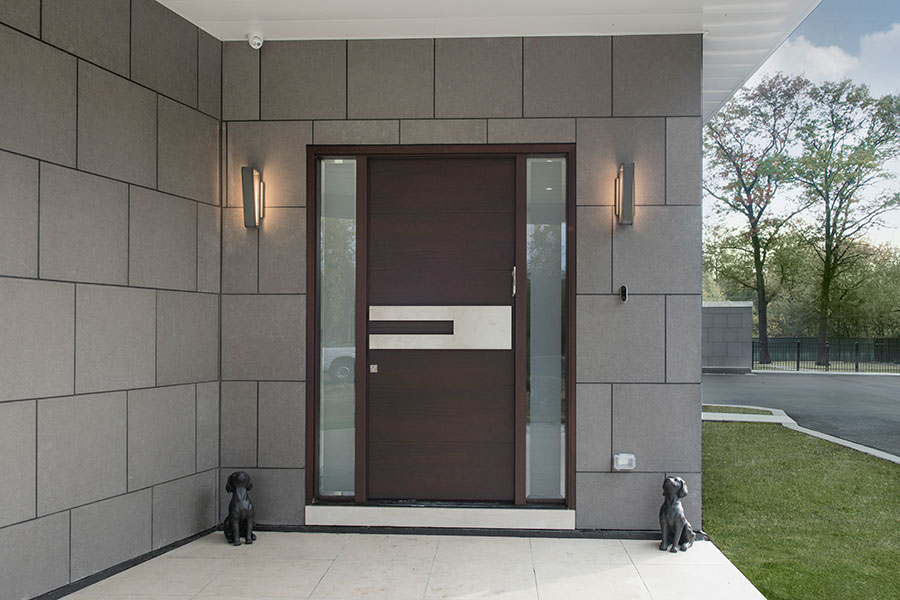
Sidelite: The side panels beside a door, typically filled with glass for decoration and lighting purposes. Sidelights can either be stile and rail construction or direct-set. Our in-stock doors can come with two sidelights or none, but not one.
Smart Lock: A locking mechanism that is equipped with a keypad and/or wifi connect so the door can be opened without a key.
Stiles: Two outer vertical pieces/edges of a traditional stile and rail door. There is the hinge stile and the lock stile.
Sticking: a thin piece of material around the panel of a stile and rail door. This can be very ornate or very simple depending on the style the customer is seeking.
Strikeplate: A plate on the frame located where the deadbolt and latch engage. It protects the frame from the repeated contact that happens when the door is opened and closed, and reinforces the frame so it is harder to break down the door.
Swing: Used to describe the direction that the door moves. A door can be Left Hand IN-swing, Left Hand OUT-Swing, Right hand IN-swing, or Right Hand OUT-swing. Residential doors are almost always inswing, and commercial doors are almost always outswing. The easiest way to determine the swing of a door is to look at it from the EXTERIOR side of the door and see which side the HINGES are on. The door will naturally swing towards the hinges.
Tempered Glass: This is a type of safety glass that has been heated and cooled so that it shatters into small pieces when broken. All of our doors come with safety glass, but some are laminated as opposed to tempered. The type of safety glass used depends on the size and texture of the glass.
Threshold: The bottom piece of the door frame usually constructed of aluminum. Our thresholds are either adjustable or flat ADA.
Threshold Extension: Doors with large jamb depths require thick frames and thick thresholds. A Threshold extension can be added to a standard threshold and make it fit a larger jamb. Our in-stock Jamb Extensions come standard with Threshold extensions.
Transom: A window attached to the top of a door. We don’t carry in-stock transoms, so any door with a transom is a custom project. Transoms can come in many sizes and shapes.
Trim: Any decorative strips around the interior or exterior side of the door. Interior trim is called Casing and exterior trim is called Brickmould.
Triple Glaze: Three layers of glass sandwiched together. There is always a gap between the layers for insulation. Decorative glass is often triple glazed so that it feels smooth and is easier to clean.
Unit Size: This is the size of the door WITH the frame. If the unit has sidelights or a transom, they would be within the Unit Size. This must be determined by the person who will be installing the door and is the most important dimension for ensuring a perfect fit.
Weather-Strip: The flexible strips surrounding the door panel designed to keep out drafts and water.